
The Reserve Bank on Friday said it will soon commence the pilot launch of e-rupee for specific use cases with a view to bolstering India's digital economy, making payment systems more efficient, and checking money laundering. In a concept note on Central Bank Digital Currency, the RBI said CBDC is aimed to complement, rather than replace, current forms of money and is envisaged to provide an additional payment avenue to users, not to replace the existing payment systems. "Supported by state-of-the-art payment systems of India that are affordable, accessible, convenient, efficient, safe and secure, the Digital Rupee (e?) system will further bolster India's digital economy, make the monetary and payment systems more efficient and contribute to furthering financial inclusion," the paper said.

Former Reserve Bank of India Governor Duvvuri Subbarao has said the central bank could lose control over money supply and inflation management if cryptocurrency is allowed in the country. Speaking at a webinar organised by the National Stock Exchange (NSE) and New York University (NYU) Stern School of Business, Rao also said India's case for issuing a central bank digital currency (CBDC) may not be strong as there are capital controls. "Crypto is backed by algorithms and there is fear that the central bank might lose control over money supply and inflation management.

The central bank will appear vacuous if it holds fire next week following its ultra hawkish guidance at the last monetary policy review.

According to report by Dun and Bradstreet, central bank expected to maintain status quo on policy rate.
.jpg)
Industry's demand for a reduction in the repo rate, currently 8 per cent, has gained momentum after wholesale and retail inflation eased in February.
.jpg)
Many countries, including Japan, are having deflation and they are trying to go back to an era of inflation.

The central bank can directly print money and finance the government, but it should avoid doing so unless there is absolutely no alternative, former RBI governor D Subbarao on Wednesday said while pointing out that India is 'nowhere' near such a scenario. In an interview with PTI, Subbarao suggested that to deal with the second wave of COVID-19 induced slowdown in the economy, the government can consider Covid bonds as an option to raise borrowing, not in addition to budgeted borrowing, but as a part of that.
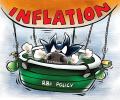
The Reserve Bank of India on Friday raised the retail inflation forecast for 2021-22 to 5.7 per cent due to supply side constraints, high crude oil and raw materials cost. The RBI in June had pegged the retail inflation estimate at 5.1 per cent for the current financial year. The RBI has the mandate to keep inflation in a band of 2-4 per cent, with a tolerance level of 2 per cent on either side.

Reserve Bank Governor Shaktikanta Das on Wednesday said in the wake of appreciating US dollar, the movement of rupee has remained least disruptive as compared to its peers, and the size of foreign exchange reserve is comfortable. On a financial year basis (from April to October 2022), the rupee has appreciated by 3.2 per cent in real terms, even as several major currencies have depreciated, he said while announcing the latest set of bi-monthly monetary policy. "The story of the rupee has been one of India's resilience and stability," the Governor said while pointing out that the appreciation of the US dollar this year, which precipitated large-scale depreciation of all major global currencies including the Indian rupee, has drawn wide attention.

Gokarn was the first Indian central banker who regularised warnings to the government, through the monetary policy statement, on the need to reduce fiscal deficit.

He will be the eighth Deputy Governor to be made Governor at RBI
The Reserve Bank may be hitting the end of its tolerance for high inflation and will most likely hike interest rates in the first half of 2022, analysts said on Friday. The central bank will also start rolling back its accommodative policies which have led to easy liquidity conditions, they said. The view from analysts came even as inflation cooled down to 5.6 per cent for July, after two months of breaching the upper end of the RBI's tolerance band of 6 per cent.

Bajaj Finance was the top gainer in the Sensex pack, rising around 4 per cent, followed by Maruti, SBI, Bajaj Finserv, Sun Pharma and Asian Paints. NSE Nifty rallied 293.05 points to 17,469.75.
Central bank may raise the limit on repo borrowings or purchase more of govt bonds.
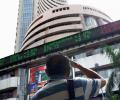
The BSE Mid-cap index gained 1.1% while the Small-cap index surged 1.3%, outperforming the benchmark indices

Moody's Ratings on Wednesday said India's economic growth will exceed 6.5 per cent in the next fiscal, up from 6.3 per cent this year, on higher government capex and consumption boost from tax cuts and interest rate reduction. Projecting a stable outlook for the banking sector, Moody's said although the operating environment of Indian banks will remain favourable in the next fiscal, their asset quality will deteriorate moderately after substantial improvements in recent years, with some stress in unsecured retail loans, microfinance loans and small business loans.
ICICI Bank, the second-largest private sector lender and state-owned Indian Bank on Monday raised their lending rates across all tenors in anticipation of a rate hike by the RBI later this week. The rates have been increased across all tenors under the marginal cost of funds-based lending rate (MCLR) system, a move that will make EMIs expensive for those who availed loans benchmarked against the MCLR. Under the revised rates, effective August 1, ICICI Bank's one-year MCLR has increased by 15 basis points or 0.15 per cent to 7.90 per cent, while the overnight MCLR rose to 7.65 per cent, as per information posted on the bank's website.
The Reserve Bank of India (RBI) may not go in for key policy rate cuts in its quarterly policy review slated for January 23, said a senior finance ministry official.
Days after the government said the Reserve Bank will introduce a digital currency in 2022-23, Governor Shaktikanta Das on Thursday said the central bank does not want to rush and is carefully examining all aspects before introduction of the Central Bank Digital Currency (CBDC). He, however, declined to give any timeline for the launch of the CBDC. In her Budget 2022-23 speech, Finance Minister Nirmala Sitharaman had announced that the RBI will introduce a digital currency in the next financial year beginning April 2022 to boost the digital economy and for more efficient currency management.

The Reserve Bank of India's interest rate decision, domestic macroeconomic data and global trends will dictate terms in the equity markets this week, analysts said. Trading activity of Foreign Portfolio Investors (FPIs) will also influence markets, they added. "The Indian market will be closely monitoring the Reserve Bank of India's Monetary Policy Committee (MPC) meeting scheduled for June 6-8, 2023. Aside from that, market participants will be keeping an eye on the progress of monsoon," said Pravesh Gour, Senior Technical Analyst, Swastika Investmart Ltd.
The Reserve Bank of India on Friday cut short-term lending rate by 0.25 per cent.
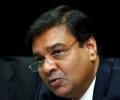
"We want a drop in interest rate. This (interest rate) is a huge problem now for us. Real interest rate in India today is touching six percent," Ficci chief Pankaj Patel said, arguing that there should be balance between growth, inflation, and interest rates.

Top Sensex gainers include Hero MotoCorp, Bajaj Auto, Asian Paints, IndusInd Bank, HUL, and Maruti, rallying up to 5.87 per cent. While, ICICI Bank, NTPC and ITC slipped up to 0.13 per cent.

S&P Global Ratings on Tuesday upped India's GDP growth forecast for the current fiscal to 6.5 per cent, citing lower crude prices, monetary easing and normal monsoon, and said the ongoing geopolitical tensions are unlikely to put a "significant pressure" on the rupee or inflation.
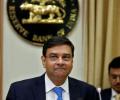
Governor Urjit Patel and his deputies spoke to the media about the central bank's decision to raise the repo rate.
Ahead of the mid-quarter review of the monetary policy on December 18, RBI Deputy Governor Subir Gokarn on Saturday said inflation continues to be the primary concern for the central bank.

In a surprise move late Friday, RBI raised its short-term lending and borrowing rates -- the repo rate (the rate at which it lends to banks) and the reverse repo rate (the rate at which banks park their surplus funds with it) -- by 0.25 per cent each to 5 per cent and 3.75 per cent, respectively, to cool off runaway inflation, which has already crossed the central bank's forecast for March at 8.5 per cent, signalling interest rake increase.
The Reserve Bank on Tuesday allowed banks to open ATMs outside their branches without permission from the central bank.
Given that food inflation remains high, the inflation outlook will be influenced by concerted efforts to break food inflation persistence.

The rupee has remained largely stable against the US greenback in the current calendar year (CY 2024), depreciating by just 0.59 per cent so far. However, it has considerably weakened against the euro and pound. The local currency has depreciated by 1.6 per cent against the euro and 5.6 per cent against the pound, as both currencies strengthened against the dollar during this period.
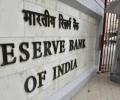
RBI is committed to bringing down retail inflation to eight per cent by January 2015 and six per cent by January 2016.
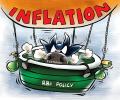
The Reserve Bank on Wednesday projected inflation to come down below the upper threshold level of 6 per cent by March quarter of the current fiscal. RBI Governor Shaktikanta Das said the central bank will keep 'Arjuna's eye' (focus) on the evolving inflation dynamics and will remain 'nimble and flexible' to deal with the price situation. Global commodity prices, including crude oil, have undergone some downward correction, but uncertainty continues to surround the near-term outlook in view of the prolonging geo-political hostilities. Moreover, the resurgence in domestic services sector activity could also lead to price increases, especially as firms pass on input costs.
The Reserve Bank of India on Monday said inflationary pressures because of oil and food prices are likely to continue, giving an indication that monetary policy could be tightened further when it comes for review on Tuesday.

The move will likely attract more retail investors.

Shaktikanta Das said in Washington, DC, that there was nothing sacrosanct about the 25 bps rate cut and that monetary policy could be well served by calibrating the size of the policy rate to the dynamics of the situation, and the size of the change itself could convey the stance of policy.

To the extent that monetary variables affect investment, the weather, thus, looks far less clement.
Government incentives to grow rice and wheat as part of a subsidised food programme for the poor also keep prices high.

RBI said inflation in the second half of the current fiscal is projected at 2.7-3.2%. It retained its GDP forecast for the current fiscal at 7.4%
